


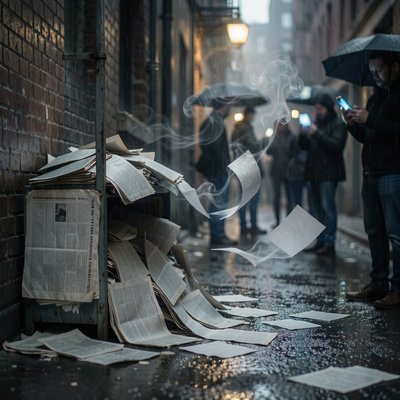
One of the more uncomfortable conclusions from HuddleWorld’s first year is that ordinary news seems to have very little value. News is a commodity. That may sound absurd at first. We live in an age in which billions of people consume news every day. They scroll headlines in the morning, check updates on their phones during lunch, watch breaking news at night and argue about politics, scandals, wars, celebrities, disasters and crises in between.
And yet most people do not want to pay for news.
That is the contradiction. People are addicted to news, but they do not value it enough to fund it directly. They want it constantly, instantly and everywhere, but preferably for free. The result is a broken system in which news is consumed like air but paid for like rubbish.
This is not merely a business problem for newspapers. It is a democratic problem.
A functioning democracy needs a free press. After freedom of speech and the right to demonstrate, press freedom is one of the central pillars of a transparent society. Citizens need independent information. They need investigation, context, contradiction and exposure of power. Without journalism, governments become less accountable, corporations become less visible, and public debate becomes easier to manipulate.
But journalism costs money. Reporters need salaries. Editors need time. Legal risks must be carried. Investigations can take weeks or months. Foreign correspondents, data analysis, photography, fact-checking, technical infrastructure and security all cost real money.
If citizens are not willing to pay for that, someone else will.
And whoever pays will eventually influence the product.
That is the core problem. If readers do not fund journalism through subscriptions, then news organisations must rely on advertising, sponsorship, government support, donors, platform distribution or ideological backers. Each of those models comes with pressure. Sometimes the pressure is explicit. More often it is subtle. But it is always there.
Advertising is the most familiar model. Traditional newspapers survived on it for decades, and digital media depend on it even more brutally. But advertising does not reward truth. It rewards attention. The article that explains a complicated policy issue carefully is not automatically more profitable than the article that makes readers angry. A calm investigation may be less valuable to advertisers than a scandalous headline. Outrage travels faster than nuance, and fear keeps people watching.
This is why so much news feels like permanent emergency. Every injustice, every war, every political insult, every crime and every celebrity conflict is presented as if it might land on your own doorstep tomorrow morning. The world is dangerous, yes. Injustice exists, yes. Wars matter, yes. But the news industry often packages distant events as immediate personal threat because fear is sticky. Fear keeps attention. Attention sells advertising.
Political news is often even worse. Much of it consists of politicians saying something about other politicians. Usually that the others are wrong, irresponsible, corrupt, dangerous or to blame. The public is then invited to watch the theatre as if it were governance. One side claims it first has to clean up the mess left by the previous side. The previous side says the new side is destroying the country. The cycle continues. Every day produces new statements, new outrage and very little understanding.
Celebrity news and human-interest trivia follow the same pattern. Famous people do things. Other famous people respond. Commentators interpret the response. Social media users react to the interpretation. News sites report on the reaction. The public spends time on it. Almost none of it changes the reader’s life.
That is why ordinary news is often worthless. Not because facts are worthless. Not because journalism is worthless. But because the daily flow of headlines is mostly perishable emotional stimulation. It creates the feeling of being informed without necessarily increasing understanding.
The internet has made this worse. News no longer competes only with other newspapers. It competes with influencers, video platforms, social media feeds, search engines and algorithmic outrage machines. Many so-called news creators are not trying to inform the public. They are trying to convert attention into advertising income, subscriptions, donations or influence. In that economy, “news” becomes a tool, not a public service.
Lets face it, the so called bringers of "free speech", the social media like Google, Meta (Facebook, Instangram, Whatsapp), X (aka Twitter), TruthSocial, TikTok, Pinterest, SnapChat, they al would not survive without advertisements. And the companies paying for advertisement want "hits". So, there you go. Feed potential consumers with "news" that attracts, that touches emotions as hard as possible, that addicts, and you have a deal.
The alternative is not simple government funding either. Publicly funded journalism can be valuable, but it also carries an obvious danger. If the state becomes the main payer, the state inevitably becomes part of the story. Even when politicians do not directly interfere, the dependency exists. A press funded mainly through taxation may remain professional, but it will always face the suspicion that it is too close to power. Supporters and opponents both pay for it, whether they trust it or not.
So the public faces an uncomfortable choice. Either citizens pay for journalism directly, or they accept that journalism will be shaped by advertisers, platforms, governments, billionaires, activists or algorithms.
There is no free press without somebody paying the bill.
This is why the slogan “news wants to be free” is so dangerous. Free news is rarely free. It is usually paid for by manipulation, advertising, data extraction, propaganda, ideology or public money. The reader may not see the invoice, but the invoice exists.
For HuddleWorld, this insight matters. It explains why ordinary news articles may receive clicks but little appreciation. News is abundant. Opinion, analysis and fiction are less interchangeable. A thoughtful financial analysis, a strong opinion piece or a continuing fictional storyline has a different relationship with the reader. It does not merely say: something happened. It tries to answer: why does it matter, what might it mean, and what kind of world are we living in?
That does not mean news should disappear. Real journalism is essential. Investigations matter. War reporting matters. Local reporting matters. Exposing corruption matters. Explaining policy matters. But the endless daily conveyor belt of headlines should not be confused with democratic nourishment.
Much of it is simply noise.
The tragedy is that society needs journalism but refuses to pay properly for it. People say they care about truth, democracy and accountability, but their behaviour often says something else. They will spend hours consuming news but hesitate to fund the people who produce it. They will complain about propaganda while refusing to support independent reporting. They will condemn clickbait while clicking on it.
That contradiction cannot last forever.
Either citizens relearn the value of journalism, or journalism will continue to mutate into entertainment, propaganda and advertising bait.
News may be a commodity, almost worthless.
But a society without real journalism becomes far more expensive in the end.