


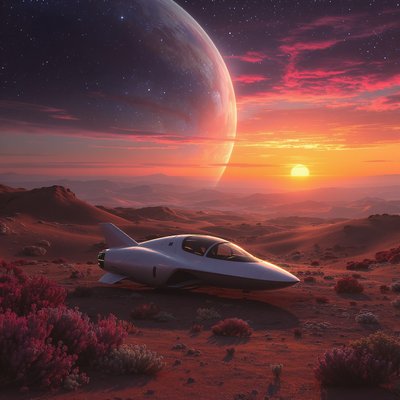
For more than a century, the human imagination has treated space as the next frontier. First the Moon, then Mars, then the outer planets, then other stars. Science fiction has made it feel almost inevitable: a successful intelligent species spreads outward. It builds colonies, harvests asteroids, terraforms planets, constructs giant habitats and eventually turns the galaxy into a human domain.
But perhaps that assumption says more about our biological past than about our intelligent future.
The usual story is simple: life wants to survive, survival requires growth, growth eventually requires expansion, and expansion eventually leads to the stars. In that view, a civilization that does not spread is either doomed, lazy or technologically limited. The galaxy becomes a test of ambition. The winners colonize. The losers stay home.
But is that really intelligence? Or is it just instinct wearing a spacesuit?
Humanity’s desire to spread has deep roots. Every living organism is shaped by survival and reproduction. Every species that exists today is the descendant of countless successful attempts to continue. So it is not surprising that humans feel the urge to explore, occupy, extract and multiply. We are a biological species before we are a technological one.
Yet intelligence changes the equation. A bacterium expands until something stops it. A forest grows where conditions allow it. A species migrates when food, climate or competition force it to. But an intelligent species can ask: should we?
That question may be one of the most important signs of real maturity.
When we look for extraterrestrial life, we often assume advanced civilizations would be visible. They might send radio signals, build megastructures, alter stars, or leave detectable energy signatures. This assumption lies behind much of the public imagination around the Drake equation and the Fermi paradox: if the galaxy is old and large, and if life is common, then where is everybody?
But perhaps the question itself contains a hidden mistake. Maybe advanced intelligence does not necessarily become louder. Maybe it becomes quieter.
Earth is about 4.5 billion years old. For nearly all of that time, it was invisible as a technological world. Then, in only a few centuries, one species moved from fire, sail and muscle power to radio, nuclear energy, satellites, genetic engineering and artificial intelligence. For a brief moment, we became a noisy planet. We leaked radio signals. We detonated nuclear weapons. We lit up the night side of Earth. We filled orbit with machines.
From the outside, this might look like the birth of a technological civilization. But it may also look like adolescence.
Already, our technologies are becoming less accidentally visible. Communications move through cables, tight beams, encrypted networks and satellites. Industrial systems become more efficient. Pollution is increasingly seen not as a sign of progress, but as a failure of design. A mature civilization may not produce larger and larger signals. It may produce fewer leaks, less waste and smaller footprints.
In other words, the detectable phase of a civilization may be short. Not because every civilization destroys itself, although that remains possible, but because any civilization that survives long enough may learn not to shout.
This has consequences for how we think about mankind’s future. The heroic version says: we must spread across the galaxy to survive. But survival alone is not a sufficient moral argument. A virus also spreads to survive. Cancer spreads to survive. The question is not whether expansion helps the expanding organism. The question is whether expansion is justified.
If Mars is sterile, then building a human settlement there may be ethically simpler. But if Mars has even microbial life, the question changes. Do we have the right to contaminate it? If Europa or Enceladus contains a hidden biosphere, is it a future human resource or a protected alien world? If we discover a planet with primitive life around another star, should our descendants terraform it, study it, avoid it, or defend it from ourselves?
The old frontier mindset answers too quickly. It sees empty land, unused resources and human destiny. But history should make us cautious about that language. Frontiers were rarely empty. Expansion often looked glorious from the perspective of the expanders and catastrophic from the perspective of those already there.
Space may not contain indigenous civilizations on every rock, but it may contain something equally important: independent origins of life. A second tree of life, even microbial, would be one of the greatest discoveries in history. To destroy or contaminate it for mining rights, settlement dreams or national prestige would not be progress. It would be vandalism on a cosmic scale.
That does not mean mankind should never leave Earth. There are strong reasons to explore. A single-planet species is vulnerable. Asteroids, supervolcanoes, pandemics, climate failure, war or long-term solar evolution could eventually threaten human survival. Scientific curiosity is also noble. To see other worlds, understand them and perhaps build small protected outposts may be part of a responsible future.
But there is a difference between exploration and expansionism.
A mature spacefaring humanity might send probes, telescopes, archives and carefully controlled research missions. It might build habitats in places that are genuinely lifeless. It might preserve Earth as the biological centre of human civilization rather than treating it as a disposable launchpad. It might create backup settlements without turning every reachable world into a human possession.
This would be a very different route for mankind. Not the empire of the stars, but the guardian at the edge of them.
Such a route also changes the meaning of intelligence. We often measure intelligence by what a species can do: split atoms, alter genes, build machines, cross space. But perhaps the deeper measure is what a species can choose not to do. Power is not maturity. Restraint is.
That may also offer a softer answer to the silence of the universe. Perhaps the galaxy is not empty. Perhaps life is common, complex life is rare, and technological life is rarer still. But among the civilizations that survive their dangerous youth, perhaps many become quiet. They stop broadcasting carelessly. They stop expanding aggressively. They learn that the universe does not need to be conquered in order to be understood.
This possibility is uncomfortable because it removes mankind from the centre of the drama. We may not be destined to become the loud heirs of the Milky Way. We may be one young species, briefly noisy, trying to decide whether intelligence means more control or more wisdom.
The great question for the next centuries may therefore not be: can we spread through the universe?
Technically, perhaps one day we can.
The better question is: what kind of species would deserve to?
If we carry our present habits outward — extraction, pollution, rivalry, conquest and short-term thinking — then spreading beyond Earth would not solve the human problem. It would export it. We would become not a spacefaring civilization, but an invasive one.
But if we learn restraint, protection, patience and humility, then leaving Earth could become something else. Not an escape from responsibility, but an extension of it. Not mankind claiming the universe, but mankind finally learning how to live within it.
Perhaps the future is not a galactic empire.
Perhaps the future is a quiet civilization that knows when to explore, when to listen, and when to leave things untouched.